
Floralooming with Friends: Growing Something Bigger Than Flowers
As floral designers, we’re only as good as the people who grow and supply our product. We can dream up the most beautiful ideas—installations suspended from ceilings, meadows built inside ballrooms, tables overflowing with texture—but we can’t bring those visions to life without extraordinary flowers.
When I moved from Los Angeles to the Midwest, I felt that shift deeply. In LA, I could walk into the flower market the morning of an event: hundreds of vendors, endless options, product I could touch, feel, and inspect in real time.
Then I moved to Kansas City, and everything changed. If you wanted specialty product or a nuanced color palette, it had to be preordered. Flowers were shipped from all over the world that were more expensive and handled multiple times before reaching me. As someone who designs intuitively, who relies on seeing and feeling the product, it was overwhelming.
And then I met Colleen Payne.
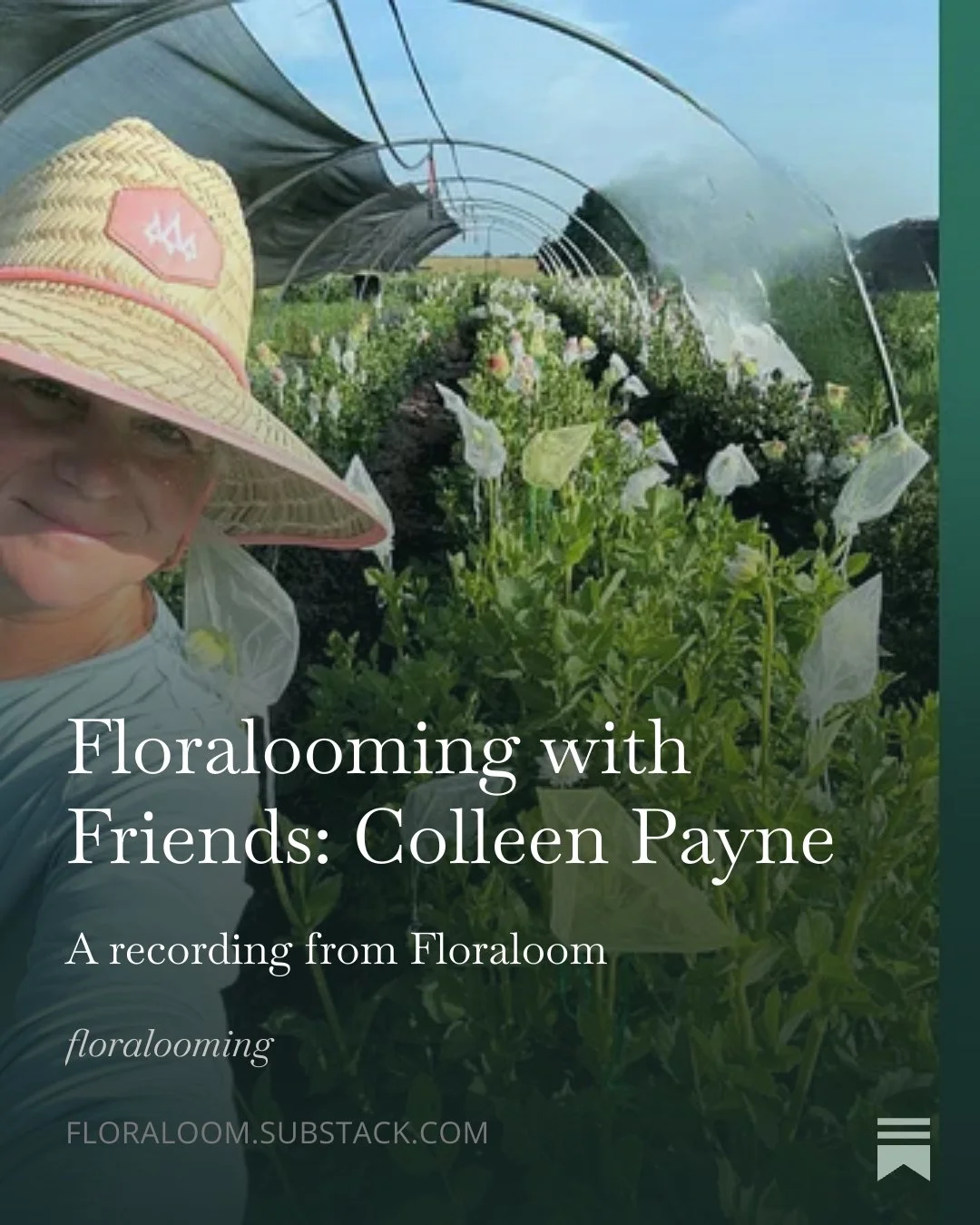
Colleen is the co-founder of the KC Flower Farmer Wholesale Market (aka: KCFFWM) and Owner of FarmStrong Flowers. To say she’s transformed the way I design would be an understatement. Through the KCFFWM she helped build, I was introduced to local flower farmers growing specialty seasonal product right here in the Midwest—product I didn’t even realize was possible to source locally.
I chatted with Colleen last fall, and you can watch our full conversation on Substack. Below are a few key takeaways from that interview.
A quick note: there’s a brief pause from 1:40–4:30 (toddler life), so feel free to skip ahead to jump back into the heart of the conversation. Thanks for understanding.
Seeing a Hole in the Market
In 2023, Colleen and fellow grower Brenda (owner of Bee & Co. Flowers) co-founded the KC Flower Farmer Wholesale Market after recognizing what she calls “a hole in the market.”
Eighty percent of flowers used in the U.S. are imported. While imports absolutely have their place—we can’t grow everything locally—there has historically been little infrastructure supporting small-scale American growers selling directly to designers.
“We’re not trying to compete,” Colleen explained. “We want to be an additional resource.”
For small flower farms (often under two acres) profitability is razor thin. Farmers markets and agritourism weren’t sustainable long-term solutions. Colleen wanted to sell directly to florists and designers. She wanted collaboration, not isolation.
So she did what entrepreneurs do best: she started.
“I always say I’m winging it 90% of the time,” she laughed. “And then we refine it the next year.”
Farming with Intention
Colleen is a first-generation farmer. When she and her husband moved from St. Louis to Kansas City in 2017, she made a bold request: instead of settling back into the suburbs, she wanted land. Twelve acres. No utilities. Just a barn and a vision.
What followed were years of research, trial and error, and hands-on education.
“I didn’t sell a single stem for the first few years,” she shared. “The education was in the doing. I needed to make the mistakes before I could say, ‘This is my product.’”
Her approach to farming is deeply values-driven. While she isn’t anti-import, she is intentional about how she grows.
“At the core, I want my little 12 acres to make a difference in the environment.”
She avoids heavy chemical use, choosing instead to support pollinators and beneficial insects. “The more chemicals you use, the less nature can fix the problems for you,” she said. “I want the good bugs to take care of the bad bugs.”
Farming this way requires patience. It means accepting some crop loss. It demands long-term thinking. But for Colleen, stewardship of the land is non-negotiable.
Designing Better Because of Farmers
One of the most unexpected gifts of this partnership has been how much I’ve grown as a designer.
Colleen doesn’t just grow flowers—she understands how we use them. In the off-season, she buys from wholesalers to stay connected to what designers are working with. She studies longevity. She considers stem strength. She’ll gently steer me away from a sunflower variety that won’t hold up for an event.
“I know flowers because I grow them,” she said simply.
That knowledge makes me better. It also makes me braver.
When I pitch ambitious designs now, I know I have a community behind me of growers who can source specialty branches that don’t ship well, fragile varieties that wouldn’t survive international transport, and seasonal product that feels alive in a way imported flowers sometimes don’t.
Community Over Competition
Perhaps the most beautiful part of this story isn’t just the flowers. It’s the community.
Both farming and floral design can be isolating careers—early mornings in the field, late nights in the studio. But what’s happening in Kansas City feels different.
Growers share knowledge. Designers collaborate on large-scale installations. We troubleshoot together. We celebrate each other.
“There’s no reason to have a cold shoulder,” Colleen said. “We can all grow together.”
At the wholesale market, you see it in action: farmers helping unload buckets, designers running into each other mid-delivery, conversations flowing easily between growers and creatives. It’s collaborative. It’s generous. It feels like momentum.
What’s Next
The KC Flower Farmers Wholesale Market has already grown to more than 200 registered buyers and Colleen’s vision is even bigger.
She hopes to expand the collective to 20–25 growers, increasing both variety and volume so designers can rely more heavily on local sourcing.
“We have to grow in order to bring the business,” she explained. “Even if that means less sales for me personally, it’s the right thing to do.”
That mindset of being long-term, community-first, mission-driven is exactly why this model is working.
Since this conversation this past fall, the KC Flower Farmers Wholesale Market has opened a permanent space in Kansas City, complete with a shoppable cooler.
Listen to our full conversation on Substack HERE.
A Personal Note
As designers, we often talk about mechanics, color palettes, installations, and trends. But behind every arrangement is a grower. A piece of land. A set of hands that planted and harvested each stem.
This conversation reminded me that beautiful events don’t begin in the studio. They begin in the soil.
And when farmers and designers work in tandem to understand each other’s processes, limitations, and ambitions, something bigger than flowers begins to grow.